How to Collect Contacts From Social Posts
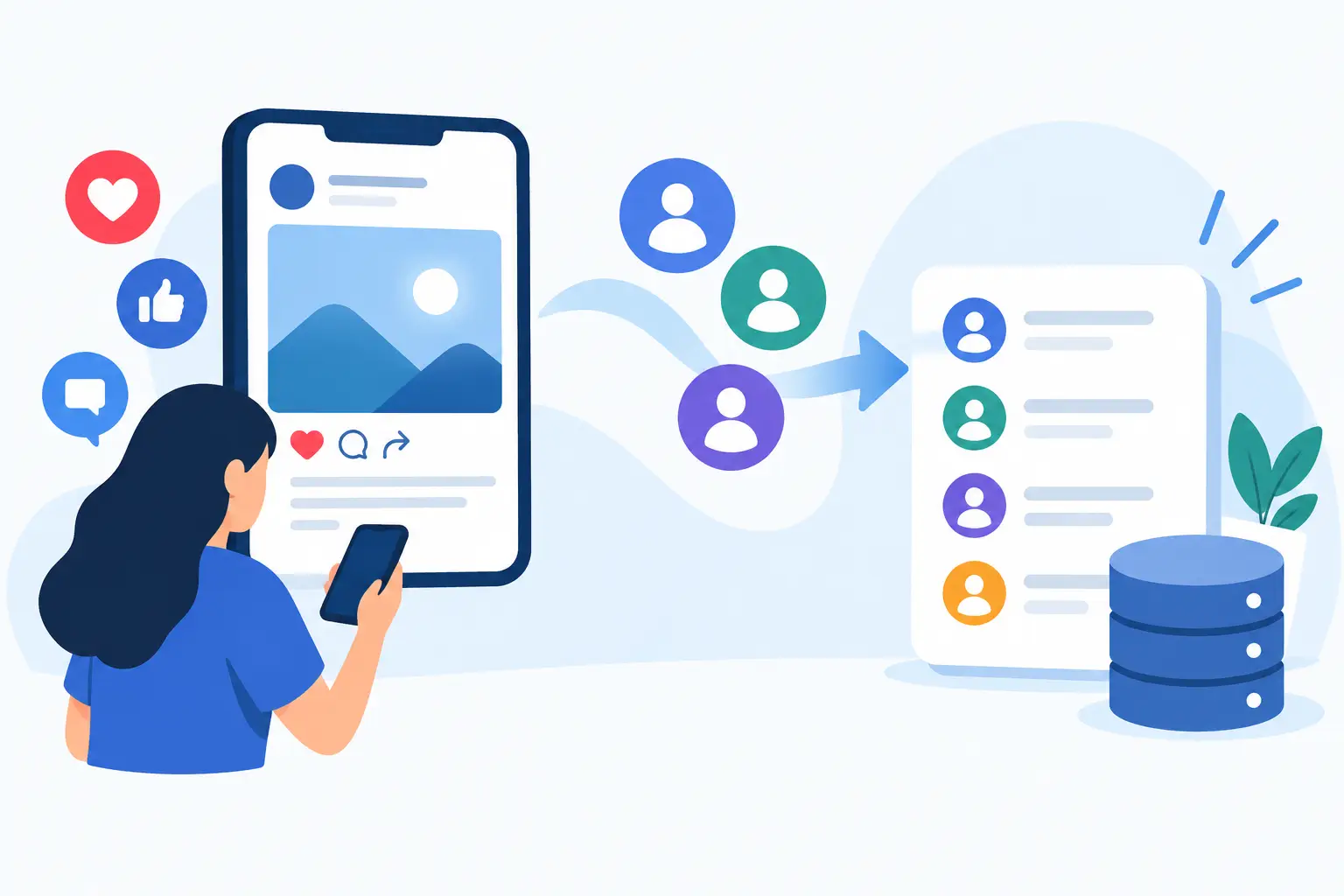
A social post can reach thousands of people and still leave you with nothing you can contact tomorrow. To collect contacts from social posts, give interested followers one clear next step: a useful resource they can access by sharing their email.
The post creates attention. The resource earns the opt-in. Your email list gives that attention a place to go.
This is not about turning every caption into a sales pitch or building a complicated funnel for every idea. It is about making your best social content lead somewhere useful.
Why likes are not enough
Likes, saves, comments, and views can tell you what resonates. They do not give you a direct way to follow up. Algorithms decide whether a person sees your next post. Platforms can change their rules, reduce reach, or make a new account feel like starting over.
An email address is different. It is permission to continue the conversation without waiting for an algorithm to cooperate.
That does not mean social media has less value. It means social works best as distribution. Use it to put a useful idea in front of new people. Then give the people who want more a simple way to raise their hand.
The mistake is asking for an email without offering a reason. “Join my newsletter” can work when someone already knows and trusts you. Most social viewers are not there yet. They need a concrete next step that extends the value of the post they just consumed.
Start with the post, not the lead magnet
You do not need to invent a giant free course, write a 40-page ebook, or record a new video series to capture leads. Start with content that already earns attention.
Look for a post that gets repeated questions, saves, shares, or comments asking for examples. That is a signal that the topic has more depth than the format allowed. Your resource can provide the rest.
A short video on planning weekly content might point to a one-page planning template. A carousel about client onboarding might point to an onboarding checklist. A post with five useful tools might lead to the full categorized list, including your notes on when to use each one.
The best resource is specific. It helps a person finish a task, make a decision, or avoid a common mistake. Broad promises attract broad curiosity. Practical promises attract people who are more likely to become subscribers, customers, or clients.
Match the resource to the moment
The closer the resource is to the post, the better the conversion usually feels. If your post teaches a creator how to outline a YouTube video, do not send them to a general “business resources” page. Offer the exact outline template or a set of hooks for the same video type.
This continuity matters because attention is fragile. A follower should understand the offer in seconds: “I liked that post. This gives me the useful next piece.”
Your resource does not need to be downloadable, either. It can be a concise reference page, a swipe file, a lesson recap, a collection of examples, or a curated set of tools. The format depends on what removes friction for the reader.
Write a post that earns the click
A post can be useful on its own and still invite the next step. In fact, it should be. Do not withhold the entire idea just to force a click. Give the audience a real takeaway first. Then offer the supporting material for people who want to apply it.
A simple structure works across short-form video, carousels, text posts, and threads: name a problem, share one useful insight, show the result or example, then mention the resource.
For example, a consultant might post: “Most discovery calls go nowhere because the questions are too generic. Ask these three questions instead.” After sharing the questions, the call to action can be: “I put the full call framework and follow-up email in a free resource. Get it from the link in my bio.”
Keep the call to action direct. Avoid vague lines like “check it out” or “learn more.” Tell people what they will receive and where to get it. “Get the checklist,” “Take the template,” and “Grab the full examples” are clearer because they set an expectation.
If the platform allows a link in the post, use it when it fits. If it does not, point consistently to one location, such as your bio link or featured resource. Do not make people hunt through old posts, comments, and profile tabs.
Publish one focused opt-in page
Once someone clicks, the job is simple: confirm the value and collect the email. This is where many creators lose momentum by opening a funnel builder and starting to assemble pages, forms, automations, file delivery, tags, and integrations.
You rarely need all of that to begin.
Create a focused resource page with a clear title, a short explanation of what the person gets, and a straightforward email field. Add a cover image or a few supporting visuals if they make the resource easier to understand. Then publish the page and use one shareable link everywhere the topic appears.
Sublead.io is built for this exact workflow: write the resource, publish one link, and collect the contacts without building delivery plumbing around it.
A focused page beats a busy page. Do not distract the visitor with a long personal story, several unrelated offers, or a menu full of places to go. They clicked for one thing. Let them get it.
Make the promise easy to scan
Your page should answer three questions quickly: What is this? Who is it for? What will I be able to do after I use it?
“30 client follow-up email templates for freelance designers” is stronger than “Free business resource.” It names the audience, the format, and the outcome. The same principle applies to the social post that promotes it.
Be honest about the value. A small resource that solves one real problem builds more trust than an inflated promise that delivers generic advice. The goal is not to collect the maximum number of emails from anyone. It is to collect contacts from people who care about the work you do.
Use the same resource across multiple posts
One resource can support more than one social post. That is the efficient part.
Create several angles around the same problem. A content planning template can be promoted through a post about common planning mistakes, a video showing your weekly workflow, a carousel with content prompts, and a short story about what changed when you stopped posting randomly. Each piece reaches people at a different point of awareness, while the resource stays the same.
This also gives you a cleaner way to test messaging. If one post earns clicks but few opt-ins, the page promise may be unclear or mismatched. If viewers engage heavily but do not click, the call to action may be too soft, too early, or not relevant enough to the post.
Do not judge the system by one post. Social distribution is uneven. A practical resource often performs over time as you mention it repeatedly in new content, comments, profiles, and video descriptions.
Keep collection separate from complexity
A growing list becomes less useful if contacts are scattered across forms, spreadsheets, direct messages, and platform notifications. Keep a central place where every opt-in lands. Export the list when you need it and use the contacts in the email tool or workflow that fits your business.
At the same time, do not rush to automate every move. For a new resource, the priority is proving that people want it. Once the opt-ins are coming in, you can decide whether a welcome email, a segmented sequence, or a sales follow-up is worth adding.
It depends on your offer. A coach booking high-ticket calls may want a personal reply to new subscribers. A newsletter operator may send a weekly issue and let trust compound. A lean marketing team may route resource signups into a product education sequence. Start with collection. Add complexity only when it earns its place.
Treat every strong post as an asset
The most useful social posts should not disappear after 24 hours or sink into your feed after a week. When a topic proves itself, connect it to a resource and keep sharing it in fresh forms.
Write the post. Publish the resource. Collect the people who want more.
That small habit turns social content from a daily visibility task into a growing source of contacts you can reach on your own terms.